
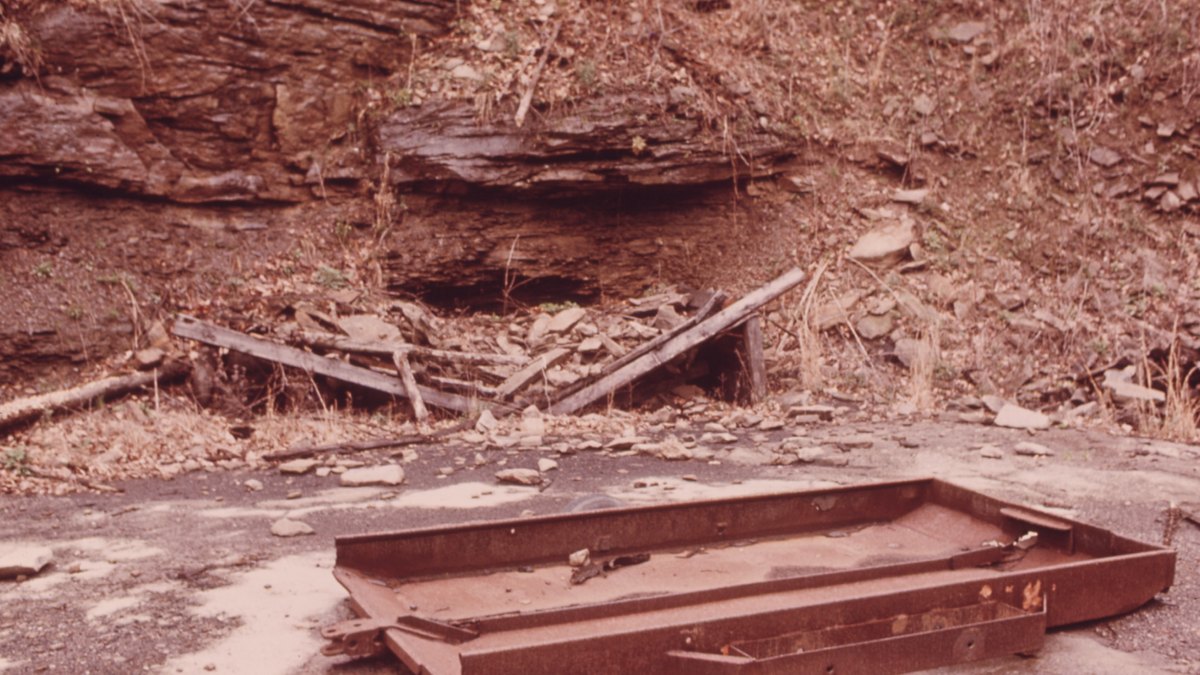
The federal list of what old coal mining left behind in Lee County runs to 19 named problem areas and 207 separate problems, from unsealed portals to about 22 miles of exposed highwall. By The Lee Daily Register’s count from the Office of Surface Mining Reclamation and Enforcement’s Abandoned Mine Land Inventory System, downloaded Nov. 21, the work still waiting for money carries a $31.2 million construction estimate. Completed work comes to $11.5 million.
Those are inventory figures, not spending. OSMRE’s data dictionary defines “unfunded” as the estimated direct construction cost of future work, “funded” as money already obligated, and “completed” as construction cost actually paid out. OSMRE’s e-AMLIS program page says planning, design, permitting and construction oversight are not tracked in the system, and Virginia Energy’s own project lists warn that real costs “may vary significantly” from the estimates.
Highwalls, portals and one mine fire
Highwalls dominate the unfunded list: 110,980 feet of lower-priority highwall and 5,150 feet of “dangerous highwall,” the category OSMRE uses for faces near populated areas, roads or other high-use places. Together that is 116,130 feet, about 22 miles, with a $17.4 million construction estimate, 56 percent of everything unfunded in the county.
Portals split evenly: 54 listed as unfunded and 54 recorded as reclaimed, plus 16 lower-priority mine openings still waiting. The largest unfunded water item is $3 million for polluted agricultural or industrial water at Stone Creek and Puckett Creek. On the completed side, water is the biggest category: $3.1 million for polluted drinking water, recorded as 419 units in the inventory, and $2.9 million for other water problems.
One entry stands apart. At Baileys Trace, in the St. Charles planning unit, the inventory lists a 50-acre underground mine fire with a $4,037,500 estimate, last revised Sept. 28, 2015, in Priority 2, one of OSMRE’s two health-and-safety tiers. Countywide, $9.5 million of the unfunded total is in those two tiers and $21.7 million in Priority 3, the land-and-water tier.
Nearly all of it sits in the St. Charles valleys
Of the $31.2 million, $29.2 million is in problem areas assigned to the St. Charles planning unit. The most expensive by unfunded estimate: Baileys Trace, $6.77 million; Stone Creek, $4.77 million; Puckett Creek, $3.11 million; Reeds Creek, $2.70 million; Gin Creek, $2.42 million; Jones Creek, $2.1 million; Upper Straight Creek, $2.06 million; Lower Straight Creek, $1.78 million; and Moore Branch, $1.65 million.
Some estimates are old. The Gin Creek entry was last revised Aug. 29, 1986; Stone Creek, Puckett Creek and Lower Straight Creek were updated in June 2026. The two newest entries, both prepared Oct. 9, 2025, are in the Ewing planning unit: Wheeler at $1.5 million and Constitutional Oaks Drive at $500,000. Both are coded only as “Other,” so the inventory does not say what the problem is.
Only $165,000 in the county is marked as funded: $150,000 for a clogged stream at Stone Creek under the infrastructure law, and $15,000 for a portal at Lower Straight Creek. Virginia Energy’s August 2026 project list for its next infrastructure-law application names one Lee County problem area, Lower Straight Creek, for water work at $1,783,683. The 2025 list also carried Stone Creek at $4,323,479.
How Lee compares with the other coal counties
Lee County is a small part of Virginia’s backlog. By our count from the same download, the seven Southwest Virginia coal counties carry $1.51 billion in unfunded estimates; Lee’s share is 2.1 percent. Lee also has the lowest ratio of unfunded to completed work among the seven: $2.70 waiting for every $1 recorded as done.
| County | Problem areas | Unfunded estimate | Completed cost | Unfunded per $1 completed |
|---|---|---|---|---|
| Buchanan | 212 | $694.1 million | $73.2 million | $9.50 |
| Dickenson | 82 | $326.4 million | $20.4 million | $16.00 |
| Wise | 94 | $279.8 million | $61.1 million | $4.60 |
| Russell | 40 | $90.4 million | $15.0 million | $6.00 |
| Tazewell | 34 | $77.2 million | $9.3 million | $8.30 |
| Lee | 19 | $31.2 million | $11.5 million | $2.70 |
| Scott | 12 | $7.9 million | $0.8 million | $9.90 |
What is coming to Virginia this year
Three federal streams pay for this work. The largest comes from the Infrastructure Investment and Jobs Act. OSMRE’s fiscal 2026 distribution table gives Virginia $21,345,775, down from $22,779,530 in earlier rounds, because the 2026 appropriations act repurposed $500 million of the program’s money. The table says the cut is spread equally over the 11 remaining annual payments.
The second stream is the traditional grant, paid from fees on coal mined today. The fiscal 2026 fee-based table gives Virginia $3 million, or $2,829,000 after a 5.7 percent sequestration cut. The third, the Abandoned Mine Land Economic Revitalization program, sends Virginia $11.25 million for fiscal 2026 to develop and repurpose former mine land, a separate purpose.
The same federal table puts Virginia’s unfunded inventory for the top three priorities at $1,173,665,274 as of Sept. 30, 2025. The fiscal 2025 table had shown $642,182,589 as of Sept. 30, 2024, so the listed need nearly doubled in a year. The tables do not explain the jump; OSMRE’s e-AMLIS page describes the inventory as changing as new problems are identified and existing ones are reclaimed.
At this year’s combined $24.2 million in reclamation grants, clearing $1.17 billion of construction estimates would take about 49 years, by our arithmetic. The 11 remaining infrastructure-law payments, if they stay at this year’s level, add up to about $235 million.
As we reported Nov. 2, federal mine records show no coal reported from Lee County since 2013. The land it left falls to Virginia Energy’s Abandoned Mine Land program in Big Stone Gap, which lists AbandonedMineInfo[at]energy.virginia.gov and 276-523-8193 as its contact. Sites qualify only if mined before Dec. 15, 1981, with no one left responsible for them.
Anyone can look up a creek or hollow in e-AMLIS by setting its Basic Query page to Virginia and Lee County.
